After a grueling 12-hour shift navigating patient rooms, busy hallways, and sterile environments, a nurse’s shoes have endured more than just physical stress. They have become potential reservoirs for a host of invisible threats like bacteria, viruses, and other microscopic pathogens.
Learning how to properly and consistently disinfect your nursing shoes is a non-negotiable professional practice. It is a critical final step in your daily infection control routine, essential for protecting your health, the safety of your home, and the well-being of those you love.
This comprehensive guide explores the science behind why this practice is so crucial, details the best methods and solutions for various shoe materials. A few dedicated minutes of shoe care can not only mitigate significant health risks but also extend the functional life.
Why You Should Disinfect Nurse Shoes
In microbiology, an inanimate object that can carry and transmit infectious pathogens is called a “fomite.” In a hospital, common fomites include stethoscopes, doorknobs, and bed rails. However, one of the most mobile and frequently overlooked motifs is the footwear worn by healthcare workers.
Your shoes act as a microbial ferry, constantly picking up contaminants from the floor and transporting them from one location to another.
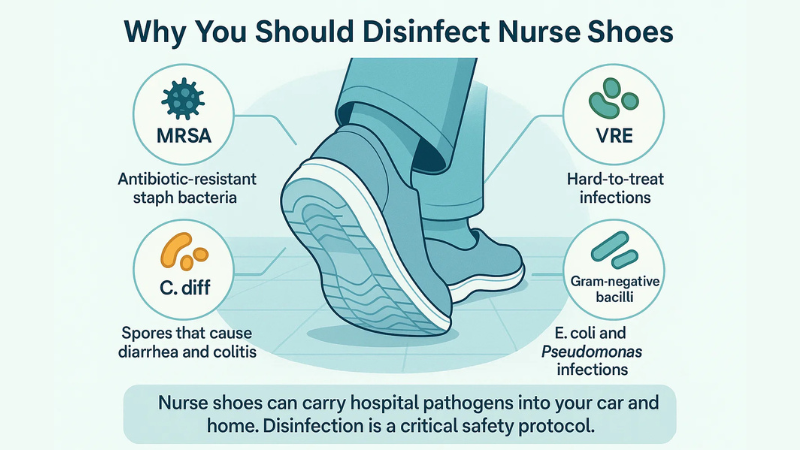
The hospital floor is a landscape of potential hazards. It is routinely exposed to everything from routine dust and dirt to dangerous bodily fluids, chemical spills, and drug residues. Scientific studies have confirmed that the soles of shoes in a healthcare setting are often colonized with a startling array of pathogenic organisms, including:
- Methicillin-resistant Staphylococcus aureus (MRSA):
A type of staph bacteria that is resistant to many antibiotics.
- Vancomycin-resistant Enterococci (VRE):
Bacteria that can cause serious infections and are difficult to treat.
- Clostridioides difficile (C. diff):
A bacterium that can cause severe diarrhea and colitis, whose spores are notoriously difficult to eradicate.
- Gram-negative bacilli:
A class of bacteria, including E. coli and Pseudomonas aeruginosa, that can cause a range of infections.
When you leave the hospital without decontaminating your shoes, you are essentially breaking the barrier of infection control. This practice directly threatens the safety of your personal environment by potentially introducing these hospital-acquired pathogens into your car and, most alarmingly, your home.
This poses a significant risk, especially to vulnerable individuals such as infants, the elderly, or immunocompromised family members. Incorporating footwear disinfection into your post-shift routine is a fundamental act of professional responsibility that helps break the chain of infection.
✅ Key Takeaway: Treat your work shoes with the same level of caution as any other piece of potentially contaminated medical equipment. Proper disinfection is not just about cleanliness; it’s a critical safety protocol.
1. When & How Often to Disinfect Nurse Shoes
Consistency and context are the pillars of an effective shoe disinfection strategy. A tiered approach allows you to adapt your routine based on daily exposure and situational risk. This will ensure your shoes remain hygienically safe without subjecting them to unnecessary wear and tear.
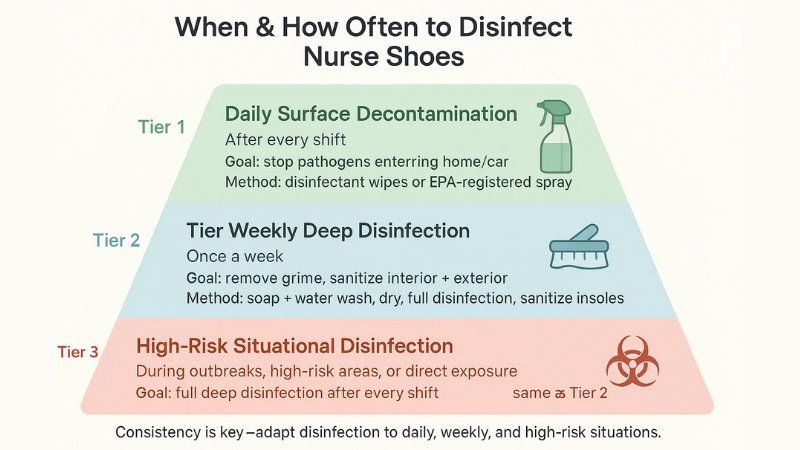
Tier 1: Daily Surface Decontamination (After Every Shift)
This is the mandatory baseline. A rapid, 2-to-3-minute disinfection should be performed immediately after every shift, ideally before you even enter your main living space. This routine focuses on eliminating the immediate bioburden from the shoe’s exterior surfaces and soles.
- Goal: To prevent the immediate transfer of pathogens from the hospital to your car and home.
- Method: A thorough wipe-down with high-quality disinfectant wipes or an even misting with an EPA-registered disinfectant spray.
Tier 2: Weekly Deep Disinfection
Once a week, dedicate 15-20 minutes to a more comprehensive cleaning and disinfection process. Physical dirt and organic matter can shield microbes from disinfectants, making this step crucial for true sanitization.
- Goal: To remove accumulated grime, eliminate biofilm, and thoroughly sanitize the entire shoe, including hard-to-reach areas and the interior.
- Method: This involves first cleaning the shoes with soap and water (as detailed in our How to Clean Nursing Shoes guide), allowing them to dry, and then performing a full disinfection of the exterior and interior using sprays, UV light, or wipes. Insoles should be removed and sanitized separately.
Tier 3: High-Risk Situational Disinfection
There are times when your daily routine needs to be elevated due to increased exposure risk. In these situations, a weekly-level deep disinfection should be performed daily.
When to Use:
- During a declared hospital outbreak or a widespread community illness (e.g., flu season, norovirus outbreak).
- After working in a high-risk area, such as an isolation room (especially for patients with C. diff or COVID-19), the emergency department, or an operating room.
- After a known, direct exposure, such as a significant spill of bodily fluids onto your footwear.
2. Best Ways to Sanitize Nursing Footwear
The market offers several highly effective methods for sanitizing footwear. The best strategy often involves using a quick method for daily decontamination and a more thorough method for weekly deep cleans.
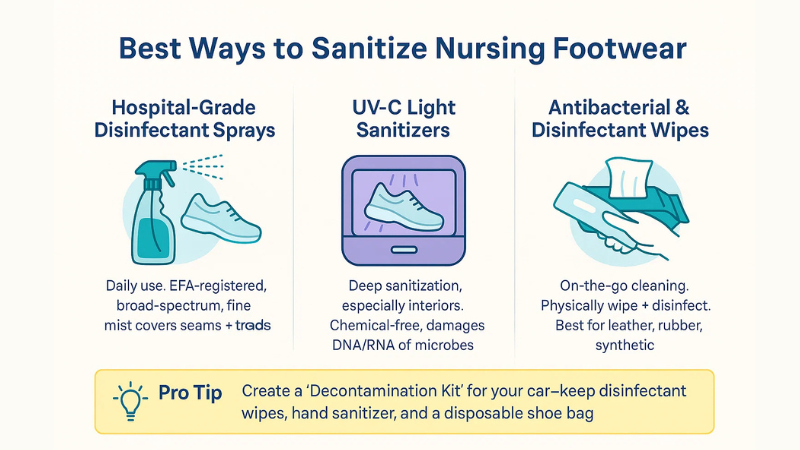
- Hospital-Grade Disinfectant Sprays:
These are the workhorses of daily disinfection. Look for sprays that are registered with the Environmental Protection Agency (EPA), as this guarantees their “kill claims” against specific bacteria and viruses have been verified.
An ideal spray is broad-spectrum, meaning it’s effective against a wide range of pathogens. The fine mist allows for even coverage over textured surfaces, seams, and the treads of the sole.
- UV-C Light Sanitizers:
This technology offers a powerful, chemical-free method of disinfection. UV-C light works at a wavelength (around 254 nanometers) that penetrates the cell walls of microorganisms, damaging their DNA and RNA and rendering them unable to reproduce and cause infection.
UV sanitizers come in two main forms: enclosed boxes where you place your shoes, and portable wands. They are exceptionally effective for sanitizing the interior of shoes, an area notoriously difficult to reach with liquids.
- Antibacterial & Disinfectant Shoe Wipes:
The ultimate in convenience, pre-moistened wipes are perfect for on-the-go decontamination. Keep a pack in your work bag or car. They allow for a tactile clean, enabling you to physically wipe away contaminants while applying the disinfectant solution.
This is particularly effective for non-porous surfaces like leather, rubber, and synthetic clogs. Ensure the wipes are designated as “disinfecting” rather than just “cleaning” to ensure they kill germs.
Pro Tip: Create a “Decontamination Kit” for your car. In a small, sealed bag, keep a pack of disinfectant wipes, a small bottle of hand sanitizer, and a disposable bag to place your shoes in for the ride home. This allows you to perform the initial decontamination before you even start your commute.
3. How to Disinfect Nurse Shoes Without Damaging Them
The ultimate goal is to achieve maximum microbial kill without compromising the integrity of your footwear. Different materials require different approaches to avoid discoloration, cracking, or degradation.
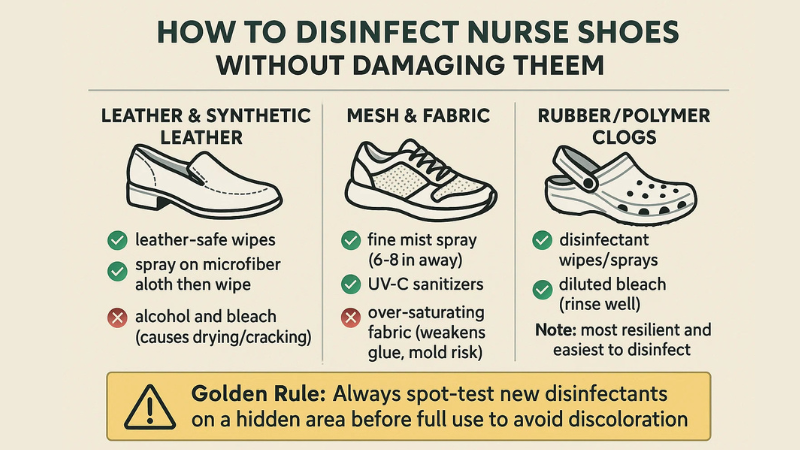
- For Leather and Synthetic Leather:
These materials have protective finishes that can be stripped by harsh chemicals like alcohol and bleach, leading to drying and cracking. The safest method is to use disinfectant wipes specifically formulated to be safe on leather.
If using a spray, apply it to a microfiber cloth first, then wipe the shoe. This gives you control over the amount of moisture applied.
- For Mesh and Fabric:
These porous materials can absorb too much liquid, which can weaken the adhesives holding the shoe together and promote mold growth if not dried properly.
The best method is a fine-mist disinfectant spray applied from a distance of 6-8 inches. Avoid saturating the fabric. UV-C sanitizers are also an excellent, moisture-free option for these materials.
- For Rubber or Polymer Clogs (e.g., Crocs, Calzuro):
These non-porous materials are the most resilient and easiest to disinfect. They can be thoroughly wiped down with any hospital-grade disinfectant wipe or spray.
They can even tolerate a heavily diluted bleach solution, provided they are thoroughly rinsed with clean water afterward to prevent material degradation.
⚠️ Warning: The Golden Rule of shoe care is always spot-test. Before using a new disinfectant product on your shoes for the first time, apply a small amount to an inconspicuous area (like the inner arch or under the tongue) and let it dry to ensure it does not cause any discoloration or damage.
4. Safe Disinfecting Solutions for Nurse Shoes
When selecting a disinfectant, it’s crucial to choose a product that is both effective against healthcare-associated pathogens and safe for your specific shoe material.
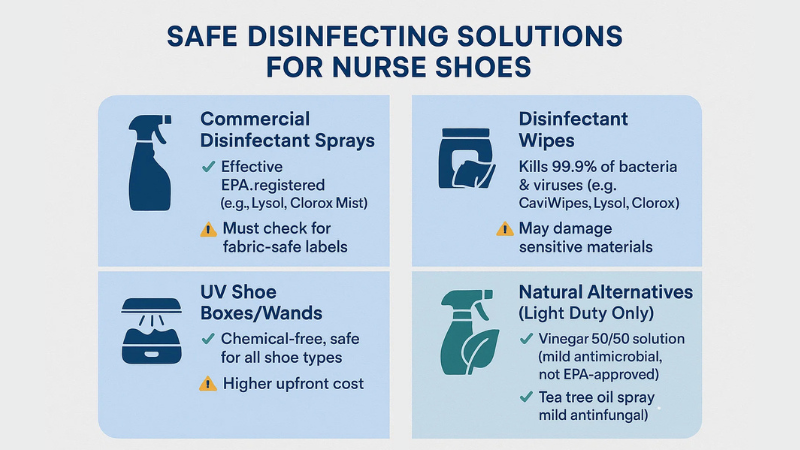
- Commercial Disinfectant Sprays:
Check the label for an EPA Registration Number. Products like Lysol Disinfectant Spray or Clorox Disinfecting Mist are widely available and effective, but always check for fabric-safe labels.
- Disinfectant Wipes:
Look for wipes that explicitly state they kill 99.9% of bacteria and viruses. CaviWipes or similar hospital-grade wipes are excellent if you can access them, but consumer brands like Lysol or Clorox wipes are also effective.
- UV Shoe Boxes/Wands:
These are a significant upfront investment but are arguably the safest long-term solution for all shoe types, as they use light instead of chemicals.
- Natural Alternatives (for light duty only):
- Vinegar Solution: A 50/50 mix of white vinegar and water has some natural antimicrobial properties and can be used for a light daily wipe-down, but it is not an EPA-registered disinfectant and will not be as effective against resilient hospital pathogens.
- Tea Tree Oil: Adding a few drops of tea tree oil to a water spray bottle can help with odor and has some antifungal properties, but again, it should not be relied upon for serious disinfection.
5. How to Disinfect Nurse Shoes After Hospital Shift (Step-by-Step)
Follow this detailed, five-step process to ensure a thorough and safe decontamination of your footwear after every shift.
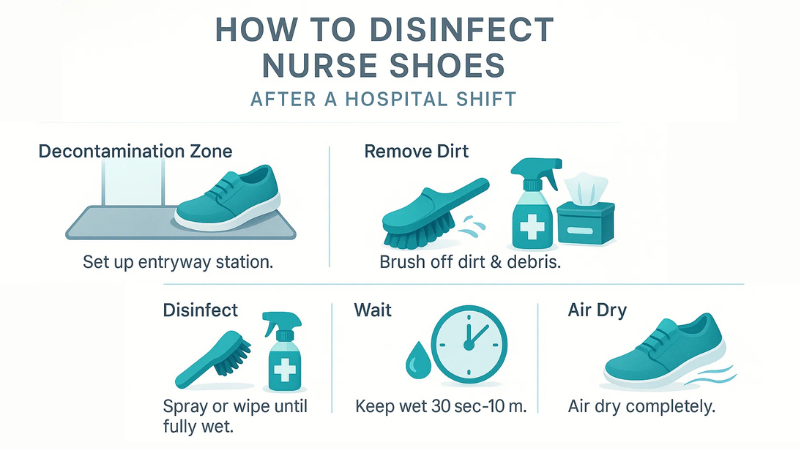
Establish a Decontamination Zone
Designate a specific area for this process, such as your garage, a mudroom, or on a protective mat just inside your entryway. This prevents you from tracking contaminants further into your home. Have all your supplies (brush, wipes/spray, disposal bag) ready.
Remove Gross Contamination
Disinfectants are most effective on clean surfaces. Before applying any solution, use a dry, stiff-bristled brush to remove all visible dirt, dust, and dried debris from the shoe uppers and soles. Pay close attention to the treads, as this is where the most grime accumulates.
Apply the Disinfectant Solution
If Using Wipes:
Use one wipe to thoroughly clean the entire surface of one shoe, including the sole, sides, heel, and tongue. The surface should be visibly wet. Use a second, fresh wipe for the other shoe to prevent cross-contamination.
If Using Spray:
Hold the can or bottle 6 to 8 inches from the shoe. Apply a complete, even mist across all exterior surfaces until they are thoroughly wet.
Respect the Contact Time
This is the most critical and often-skipped step. The “contact time” is the duration the surface must remain visibly wet for the disinfectant to kill the claimed pathogens. This time is specified on the product label and can range from 30 seconds to 10 minutes. Do not wipe the shoes dry; allow the solution to work for the full required time.
Air Dry Completely
After the contact time has elapsed, place the shoes in a location with good airflow to allow them to dry completely. This prevents any residual moisture from encouraging mold or mildew growth.
6. Deep Disinfecting vs Daily Surface Cleaning
Understanding the difference between these two practices is key to maintaining a balanced and effective shoe hygiene routine.
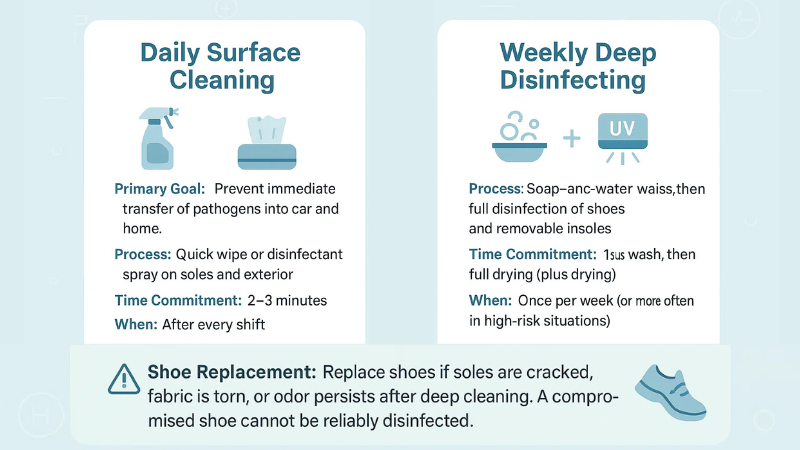
Feature | Daily Surface Cleaning | Weekly Deep Disinfecting |
Primary Goal | Immediate risk reduction and prevention of pathogen transfer into the home. | Complete removal of accumulated biofilm, dirt, and full decontamination of interior/exterior. |
Process | Quick wipe or spray of exterior surfaces and soles. | Full cleaning with soap/water, followed by thorough disinfection of all parts, including insoles. |
Time Commitment | 2-3 minutes | 15-20 minutes (plus drying time) |
When to Perform | After every single shift. | Once per week. |
Replacement: Even with perfect care, shoes wear out. It is safer to replace your work shoes when you notice deep cracks in the sole, torn or frayed fabric that can trap contaminants, or a persistent odor that deep cleaning cannot remove. A compromised shoe is a shoe that cannot be reliably disinfected.
For proper post-clean storage, see How to Store Shoes Properly.
7. Storage Tips After You Disinfect Nurse Shoes
Proper storage protects your freshly disinfected shoes from re-contamination and helps them last longer.
- Keep Shoes in a Designated “Cool Down” Area
Store your work shoes away from everyday footwear and high-traffic living areas. A dedicated shelf in a mudroom, a breathable shoe rack in a garage, or even a sealed plastic bin near the door are all excellent options.
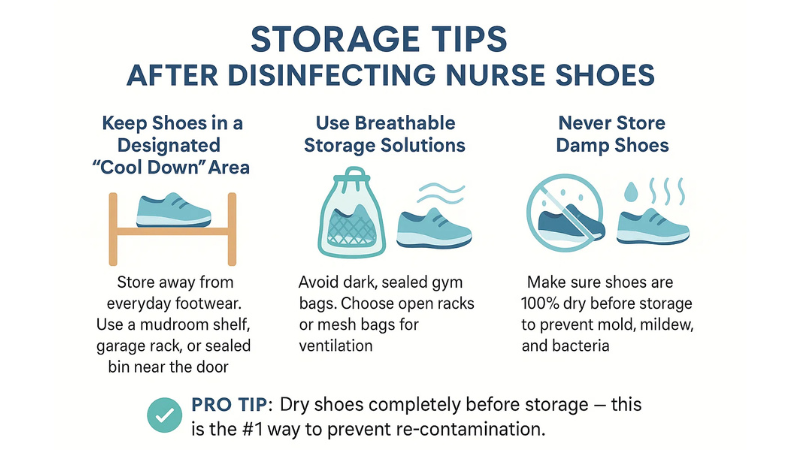
- Use Breathable Storage Solutions
Avoid stuffing shoes into a non-breathable gym bag or a dark, cramped closet. This traps moisture and creates an anaerobic environment where odor-causing bacteria can flourish. Open-air racks or mesh shoe bags are ideal as they promote continuous airflow.
- Never Store Damp Shoes
This cannot be overstated. Ensure your shoes are 100% dry, inside and out, before putting them away. If they feel even slightly damp after disinfection, allow them more time in a well-ventilated area. This is the single most important step in preventing mold, mildew, and bacterial growth.
Product Recommendations (Affiliate Section)
Investing in the right tools makes the disinfection process faster, easier, and more effective. Nurses can benefit from these shoe care essentials:
Products | |
EPA-Registered Shoe-Safe Disinfectant Sprays | |
Hospital Grade Disinfectant Wipes | |
UV Shoe Sanitizer Box |
Conclusion
Taking the time to disinfect your nursing shoes is an integral part of your professional duty to uphold infection control standards. This simple habit acts as a critical firewall, protecting you, your patients, and your family from the invisible dangers.
By integrating a consistent routine of daily sprays or wipes, weekly deep cleans, and proper storage, you can effectively prevent the spread of germs beyond the hospital walls. This not only ensures your footwear remains hygienically safe but also preserves its condition.
FAQs on How to Disinfect Nurse Shoes
What’s the best way to disinfect nursing shoes daily?
The most efficient and effective daily method is a thorough wipe-down with a hospital-grade disinfectant wipe or an even misting with an EPA-registered disinfectant spray. The key is to cover all surfaces and allow for the proper contact time listed on the product.
Can I use Lysol on my work shoes?
Yes, Lysol Disinfectant Spray is an EPA-registered product effective against many pathogens and is generally safe for most shoe materials. However, it is crucial to always spot-test on a hidden area first.
How do I disinfect fabric shoes without ruining them?
For fabric or mesh shoes, avoid soaking them. The best methods are to use a fine-mist disinfectant spray applied from a distance or to use a UV-C light sanitizer. Both methods effectively kill germs without oversaturating the material.
Are UV shoe sanitizers effective for hospital germs?
Yes, they are highly effective. Scientific studies have proven that UV-C light at the correct wavelength and exposure time is effective at killing a wide range of dangerous bacteria and viruses, including MRSA and C. diff spores, without the use of chemicals.
How often should nurse shoes be sanitized?
A surface disinfection should be performed daily after every shift. A more thorough, deep disinfection (including cleaning and interior sanitization) should be done weekly, or more frequently during flu season or known outbreaks.
Leave a Reply