
For healthcare professionals, a 12-hour shift is an endurance event. Nurses can walk between four and five miles in a single day, often on hard, unforgiving floors. Good Nursing shoes are important. But socks worn inside them are the critical interface between foot and shoe.
We are here to reveal science and strategy to choose socks for long nursing shifts. We will go beyond simple recommendations and explore the biomechanics of foot fatigue, the technical features that truly matter, the science behind different materials, and the common mistakes that can sabotage your comfort.
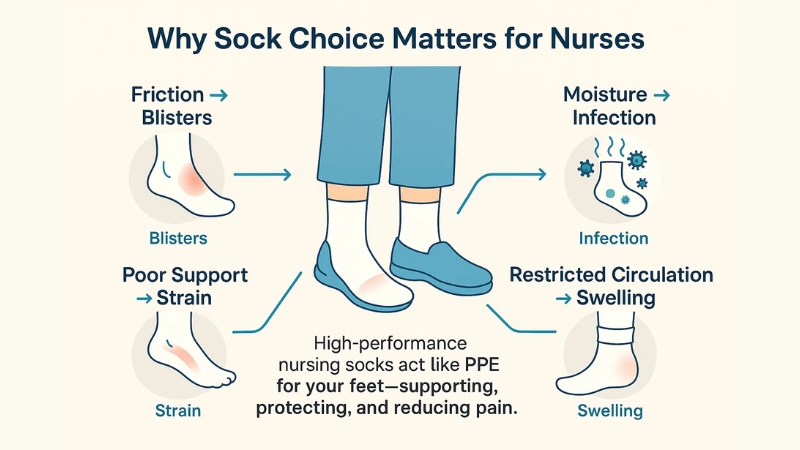
Why Sock Choice Matters for Nurses
To understand why socks are so important, we must first understand the intense physiological stress a nursing shift places on the lower body. It’s a cascade of issues that the wrong socks will actively accelerate.
- The Biomechanics of Fatigue:
Constant walking and standing cause the muscles in your feet and lower legs to work overtime. No matter how much you take care of your feet, they are bound to get tired after a long shift.
As they tire, the arch of your foot can begin to flatten (over-pronation), altering your gait and putting strain on your ankles, knees, and even your lower back.
- The Cascade of Foot Ailments:
- Friction Leads to Blisters: A poorly fitting sock bunches or slips, creating friction. This friction generates heat and separates layers of skin, forming painful hotspots that quickly develop into fluid-filled blisters.
- Moisture Leads to Infection: The wrong materials (like cotton) trap sweat, creating a warm, damp environment. This condition, known as maceration, softens the skin, making it vulnerable to blisters and creating the perfect breeding ground for fungus (Athlete’s Foot) and odor-causing bacteria.
- Poor Support Leads to Strain: Without adequate arch support or cushioning, the full force of each step is absorbed by your bones, joints, and the plantar fascia—the ligament running along the bottom of your foot. This repeated impact is a direct contributor to conditions like plantar fasciitis.
- Restricted Circulation Leads to Swelling: Prolonged standing allows fluid to pool in the lower extremities due to gravity. A sock with a tight, non-compressive band can act like a tourniquet, worsening this swelling (edema) and leading to heavy, aching legs and an increased risk for varicose veins.
✅ Key Takeaway: Pairing the right socks with the best nursing shoes for standing all day helps keep feet supported and pain-free. A high-performance nursing sock isn’t a luxury; it’s a piece of personal protective equipment (PPE) for your musculoskeletal health. It mitigates these predictable problems, allowing you to focus on patient care.
A Deep Dive: The 5 Core Features of an Elite Nursing Sock
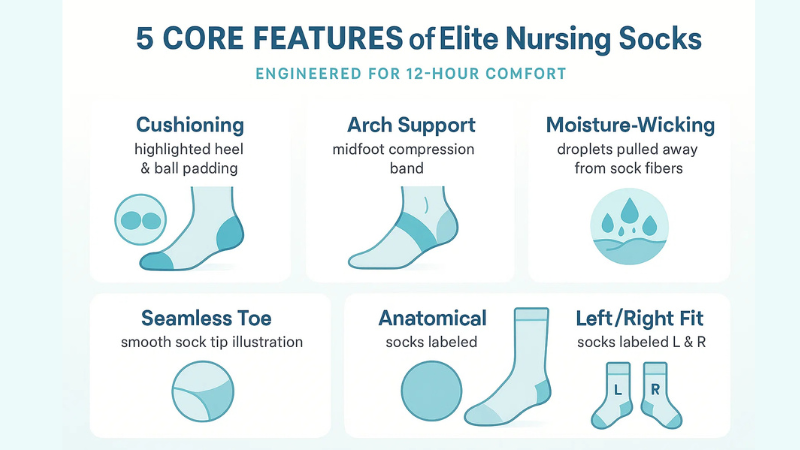
If you want to keep your feet healthy, a good post-shift foot massage isn’t enough. You also need the right pair of socks to keep the pressure minimal. When evaluating socks, look for specific technical features designed for endurance athletes and medical professionals.
1. Strategic, High-Density Cushioning
This is not about overall thickness. It’s about targeted padding in the highest-impact zones. Look for dense terry loop construction under the heel (for heel-strike impact) and the ball of the foot (for the toe-off phase of your stride). This padding acts as a shock absorber, protecting your joints from thousands of repetitive impacts.
2. Dynamic Arch Support
Superior socks have a reinforced, compressive band woven around the midfoot. This isn’t just for a “snug fit”—it provides active support to your arch.
This support helps prevent the plantar fascia from overstretching, reducing arch fatigue and lowering the risk of plantar fasciitis. It also helps keep the sock locked in place, preventing it from slipping and bunching inside your shoe.
3. Advanced Moisture-Wicking System
This is a function of the fabric’s properties. High-performance socks use hydrophobic (water-repelling) fibers like polyester or wool.
These fibers refuse to absorb moisture; instead, they pull sweat away from your skin and push it to the outer surface of the sock, where it can evaporate. This process is critical for keeping feet dry, preventing blisters, and managing odor.
4. Truly Seamless Toe Closure
Many socks have a thick, machine-sewn seam across the toes that can rub against your nails and cause intense irritation. Look for socks specifically labeled with a “seamless toe,” “hand-linked toe,” or “flat-knit toe seam.”
This construction method creates a completely smooth, undetectable seam, eliminating a primary source of friction and hotspots.
5. Anatomical Left/Right Fit
Your left and right feet are not identical. Elite socks are often designed with an anatomical fit, meaning there is a designated sock for each foot.
This allows for a more precise shape that contours to the natural curves of your foot, improving the fit of the arch support, toe box, and cushioning for superior comfort and performance.
Pro Tip: When you see a sock labeled with brand names like CoolMax® or Dry-Fit®, these are simply trademarked names for polyester blends engineered for maximum moisture-wicking. They are an excellent indicator of a performance-oriented fabric.
Compression vs. Cushioned Socks: An In-Depth Comparison
This is the most common dilemma for nurses. Both are excellent choices, but they are engineered to solve different problems.
Graduated Compression Socks
Graduated compression socks apply controlled, external pressure to the leg, tightest at the ankle and decreasing progressively up the calf. This mechanism counteracts gravity, physically squeezing the veins to increase the velocity of blood flow back to the heart.
- Who Needs Them Most:
Anyone who experiences visible swelling, “heavy” or aching legs, varicose or spider veins, or has a family history of circulatory issues.
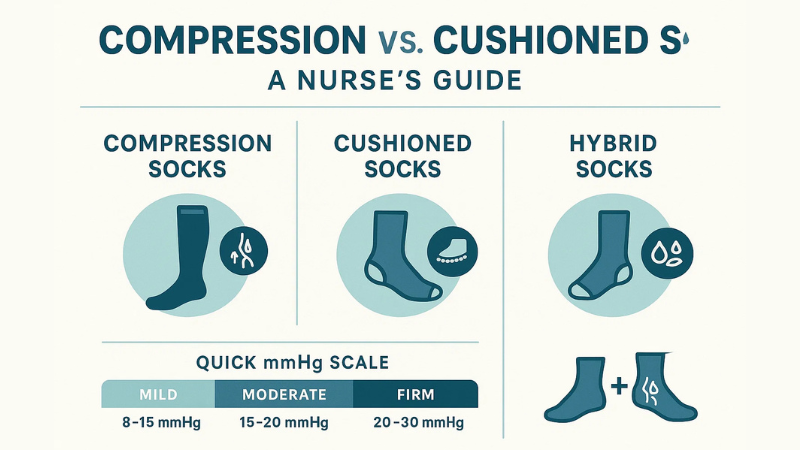
- Understanding the mmHg Scale:
Compression is measured in millimeters of mercury (mmHg).
- 8-15 mmHg (Mild): Good for minor fatigue or travel. Often not enough for a 12-hour shift.
- 15-20 mmHg (Moderate): This is the sweet spot for nurses. It provides clinically significant support to reduce swelling and fatigue without feeling overly restrictive for all-day wear.
- 20-30 mmHg (Firm): Often considered medical-grade. Recommended for managing more significant edema, varicose veins, or post-surgically. Consult a doctor before using this level daily.
- 30-40+ mmHg (Extra-Firm): Prescription-only, used for serious conditions like DVT or lymphedema.
High-Cushion Performance Socks
These socks are built for pure impact absorption. Their primary goal is to create a protective barrier between your foot and the hard floor.
- Who Needs Them Most:
Nurses who work on exceptionally hard surfaces (e.g., concrete, tile), are heavier set, or are prone to soreness on the bottoms of their feet (e.g., stone bruises, metatarsalgia).
- The Trade-Off:
The highest level of cushioning can add bulk and trap more heat. This is why pairing max-cushion socks with breathable shoes is essential.
The Hybrid Solution:
You don’t always have to choose. Many brands now offer socks that combine moderate compression (15-20 mmHg) with targeted cushioning in the heel and forefoot. These hybrid socks often represent the best of both worlds for healthcare professionals.
The Science of Sock Materials: What to Embrace and What to Avoid
The fiber composition of your sock is its most important attribute.
Material | Pros | Cons | Verdict for Nurses |
Marino Wool | Superb thermoregulation, naturally antimicrobial (odor-resistant), wicks moisture extremely well, soft and itch-free. | Can be more expensive, may require more delicate washing (air dry recommended). | Gold Standard. The best all-around performer for comfort, moisture, and odor control. |
Synthetic Blends | Highly durable, excellent moisture-wicking, fast-drying, often more affordable. Holds shape well. | Can feel less "natural," odor resistance relies on chemical treatments that can wash out. | Excellent Choice. A durable, reliable workhorse. Look for blends with Polyester, Nylon, and Spandex. |
Bamboo Rayon | Exceptionally soft, good breathability, naturally antibacterial claims. | Less durable than wool or synthetics, can stretch out and lose shape when wet. | Good Option. A great choice for comfort, but may have a shorter lifespan in a high-wear rotation. |
100% Cotton | Soft, cheap, widely available. | Hydrophilic (absorbs and holds moisture), loses shape when wet, causes blisters, promotes bacteria. | AVOID AT ALL COSTS. Wearing cotton socks on a long shift is like wrapping your feet in a wet sponge. |
Common & Costly Mistakes to Avoid While Choosing Socks for Long Nursing Shifts
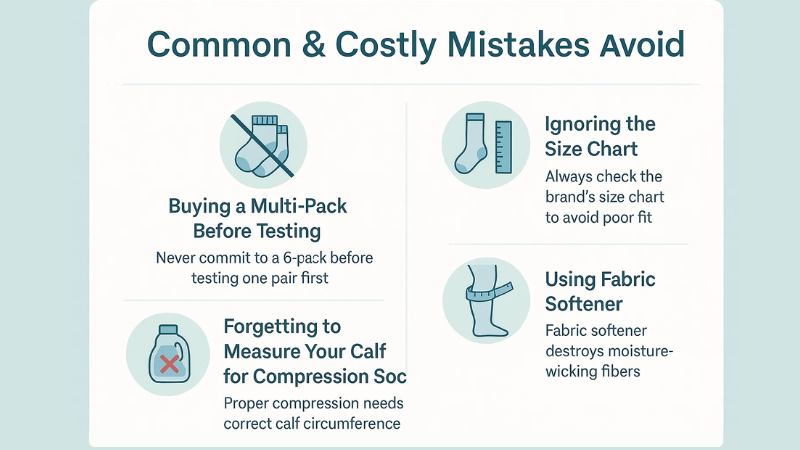
1. Buying a Multi-Pack Before Testing:
Never commit to a 6-pack of a new sock brand. Buy one single pair first. Wear them for a full, demanding shift. Test them. Wash them. If they perform well, then invest in more.
2. Ignoring the Size Chart:
Sock sizes (e.g., Medium, Large) are not shoe sizes. A sock that’s too big will bunch up, and one that’s too small will put pressure on your toes and slip down your heel. Always consult the brand’s specific size chart.
3. Forgetting to Measure Your Calf for Compression Socks:
Proper compression requires the right calf circumference. Most reputable brands will include a calf measurement in their size chart. A sock that’s too tight on the calf is dangerous.
4. Using Fabric Softener:
Fabric softeners and dryer sheets leave a waxy residue that clogs the micro-grooves in technical fibers, destroying their ability to wick moisture. It’s the fastest way to ruin a good pair of performance socks.
The Professional’s Sock Rotation and Care Strategy
To maximize the lifespan and performance of your investment, adopt a professional care routine.
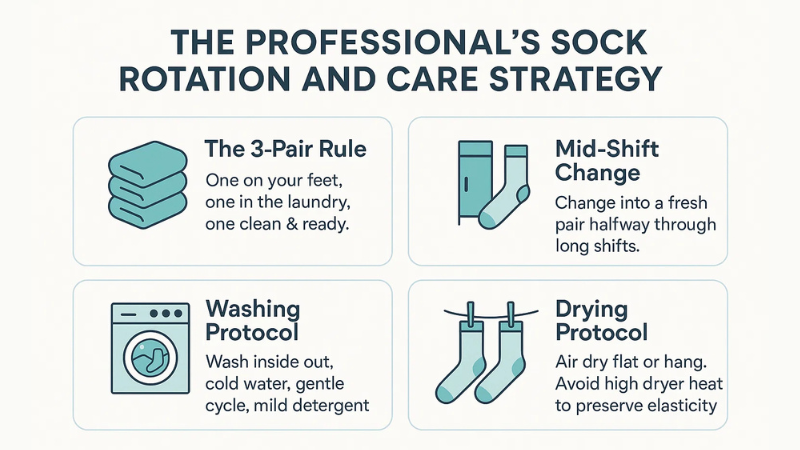
- The 3-Pair Rule:
For every work day, you should have three pairs in your rotation: one on your feet, one in the laundry, and one clean and ready to go. This ensures each pair has adequate time for its elastic fibers to rest and recover.
- Mid-Shift Change:
If you have particularly sweaty feet, keep a fresh pair in your locker and change halfway through your shift. The feeling is incredibly refreshing and is a game-changer for preventing moisture-related issues.
- Washing Protocol:
Wash socks inside out on a gentle cycle with cold water and mild detergent.
- Drying Protocol: Air dry whenever possible.
Lay them flat or hang them. The high, prolonged heat of a machine dryer is the #1 killer of elasticity (Spandex/Lycra). If you must use a machine, use the lowest heat setting.
Conclusion
In the demanding world of healthcare, every piece of gear matters. Socks are not a footnote to your uniform; they are a fundamental tool that directly influences your comfort, endurance, and long-term foot health. They are a major help when it comes to preventing foot pain during long shifts.
By moving beyond basic cotton and investing in socks with purpose-built features—like graduated compression, strategic cushioning, and advanced moisture-wicking materials—you are making a direct investment in your own well-being.
Use this guide to analyze your needs, select the right features, and care for your investment. Your feet will carry you through countless challenging shifts—it’s time you gave them the support they truly deserve.
Recommended Products (Affiliate Picks)
Product | |
Compression Socks | |
Marino Wool Socks | |
Performance Athletic Socks For Women | |
Performance Athletic Socks For Men | |
Unisex Bamboo Fiber Socks |
FAQs: Choose Socks for Long Nursing Shifts
What socks are best for standing all day in a hospital?
Compression socks are excellent for reducing swelling and fatigue, while cushioned socks with arch support are best for absorbing impact on hard floors.
Do compression socks really help during 12-hour shifts?
Yes, absolutely. They significantly improve blood circulation in the legs, which reduces swelling, aching, and the feeling of heavy, tired legs.
How do I stop my feet from sweating in work shoes?
Choose socks made from moisture-wicking materials like merino wool or synthetic blends. Avoid cotton at all costs. For heavy sweaters, bringing a fresh pair to change into mid-shift is highly effective.
Should nurses wear padded socks or compression?
It depends on your primary concern. If your legs swell and ache, choose compression. If the bottoms of your feet are sore from impact, choose padded socks.
What are the best materials for breathable socks?
Merino wool, bamboo, and technical synthetic blends with mesh ventilation panels offer the best combination of breathability and moisture management.
Leave a Reply